

I’m increasingly convinced that custom software, combined with specialised AI agents, will be the path to replacing B2B SaaS, at least to some extent.
Traditionally, buying software is a compromise. You pick the option that’s the closest fit, not necessarily one that solves all your problems. You then fit your workflows and processes around the software. Over time, this software grows and becomes bloated, while you might only need 30% of the feature set. It can even get to a point where the software slows down progress.
But building software is, or at least was, costly. When you compare the two, the compromise of buying software makes more sense in most cases.
Most companies today are already in a place where they pay for one or more LLM providers, and also pay an additional usage fee for third-party software that makes API calls to the same LLMs. The first step of this transition will be “bring your own AI,” where customers will be able to plug in their own AI or LLMs into pre-built software.
Eventually, as LLMs improve and become increasingly proficient at coding, a combination of custom, pre-built software and a specialised AI agent that thoroughly understands the codebase can ship all the necessary features.
Think of Claude Code or Cursor as a generic software developer you hire from Upwork. They’re good, but they’re not your developer. You have to explain the problems you’re trying to solve, and even then, they don’t have the company context, business goals, or your best practices.
We’ll get to a place where we have a specialised developer who is an expert in your codebase, business requirements, and company context. The role of builders will mostly shift towards maintaining these agents and deeply understanding customer problems to solve. This shift will show up first in internal-facing, workflow-heavy systems where context matters more than polish, such as HR software and internal tools.
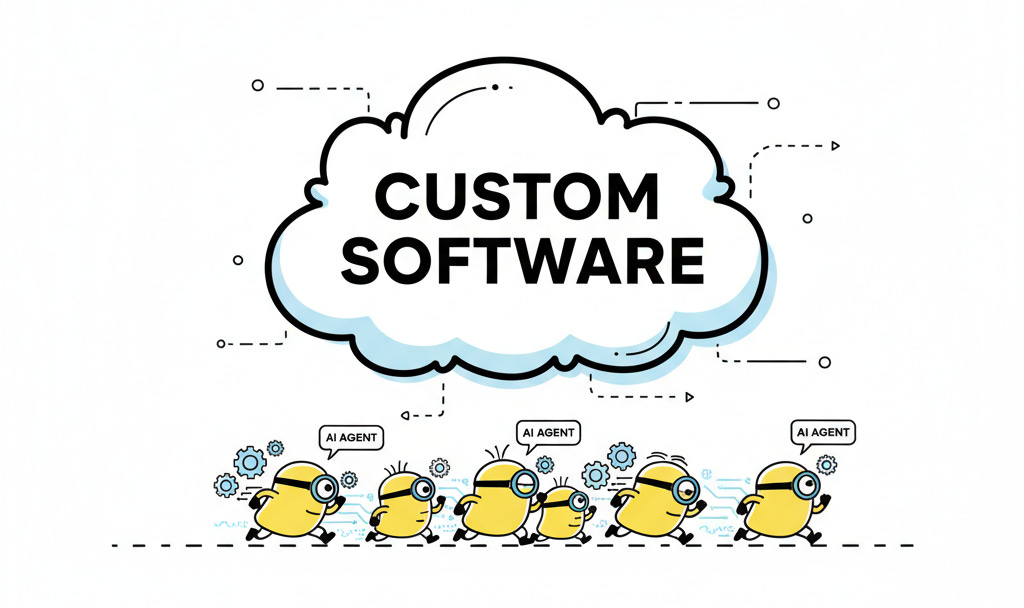
I also feel there will be a comeback of open-source B2B software: generic software with basic feature sets that companies can build on top of. Agents specialised in understanding that codebase will maintain it with the help of humans.
There are several second-order impacts in play here. Organisational memory becomes the moat: the accumulated understanding of why systems exist the way they do, encoded in codebases and the agents that maintain them. Maybe “Context Graphs” (from the recent essay) are part of the solution here, but it might also be something every company builds and maintains, rather than a standalone product.